This article will give a practical overview of filter design! We’ll begin with the theory with bode plots then build several popular filters. RLC filter behavior such as resonance and damping is explained
Introduction
A filter is defined as a circuit that passes, blocks or amplifies certain frequencies of a signal. Unfortunately (or maybe fortunately?) they are required since real-life signals are corrupted with noise.
According to the Fourier Series, a sinewave consists of multiple other sinewaves
Ideally, we want our signals to have zero DC component. However, in real life, it is rare to see this
The Bode Plot
A bode plot visually communicates the behavior of a particular filter – how it responds to various frequencies. They are extensively used in filter design.
A bode plot plots ****frequency on the z-axis and dB on the y-axis.
It Is logarithmic.
The logarithmic scale is used because filters attenuate or amplify signals by 1000x or more. Hence, the dB scale provides a convenient scale to represent these changes without extending the bode plot by a significant amount.
The log function counts the number of digits in its argument, excluding the first one.
E.g. log10(1) = 0 whilst log10(1000) = 3
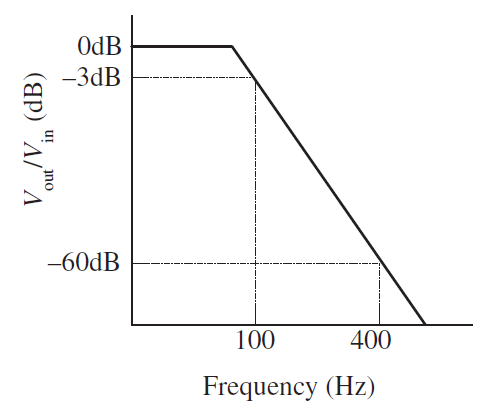
The -3dB mark/cutoff frequency (Fc) is a popular “milestone”. This represents the point at which the input-to-output power is halved AND the frequency at which the input-to-output voltage is reduced by 70% or 1/squareroot (2)
If we increase or decrease a signal by 6dB, we double or halve the magnitude respectively. This is called an octave
If we increase or decrease a signal by 20dB, we multiply or divide it by 10. This is called a decade
Every additional 20dB represents another magnitude of 10. Thus, a gain of 100 is 40dB
Firstly, we will start with passive filters, meaning their built from caps and inductors as opposed to op amps
Low-pass Filter (LPF)
This is simply a resistor in parallel with a capacitor.
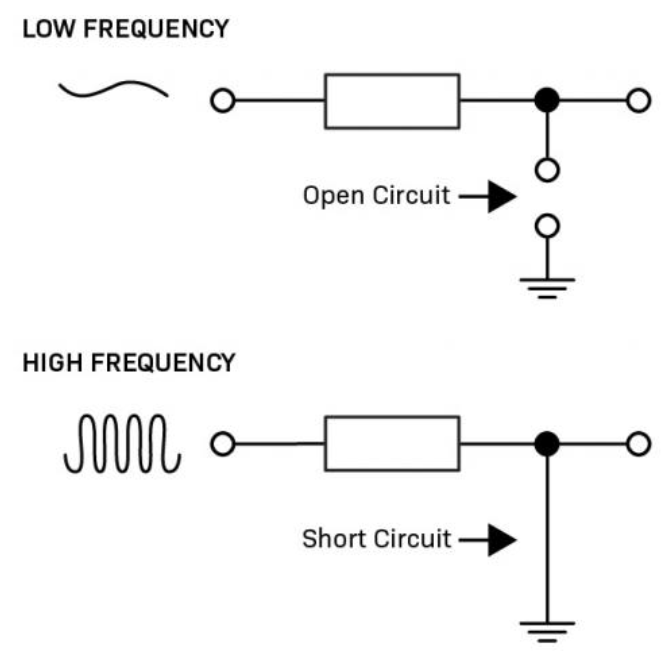
At low frequencies, the capacitor behaves like an open circuit, since the capacitance reactance (Xc) is very large. This allows low frequency signals to pass.
Recall:
X_{c} = \frac{1}{2 \pi f C}
At higher frequencies, Xc is small enough where it behaves like a short-circuit, thereby shunting high frequency components to ground. This means the higher frequencies are filtered since they do not reach the output
High-pass filter (HPF)
This filter attenuates low frequencies whilst passing higher frequencies. It’s simply a LPF with the components swapped.
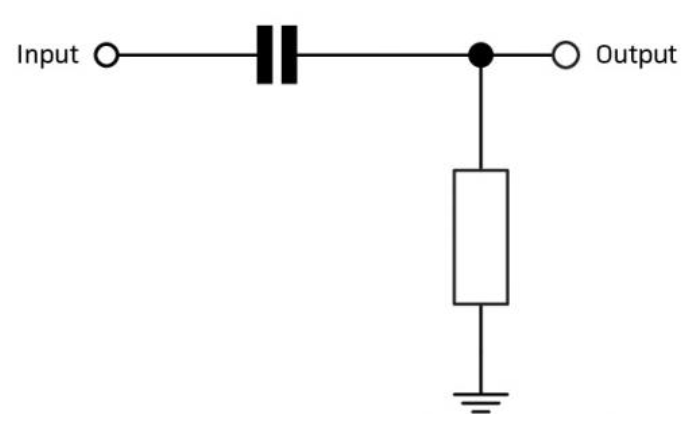
At DC, the capacitor blocks the signals. As the frequency is increased, Xc decreases. This allows higher frequency components of the signal to pass.
NOTE: Passive RC LP and HPF’s are rarely used. Instead, active filters are used
Bandpass and Bandstop Filters
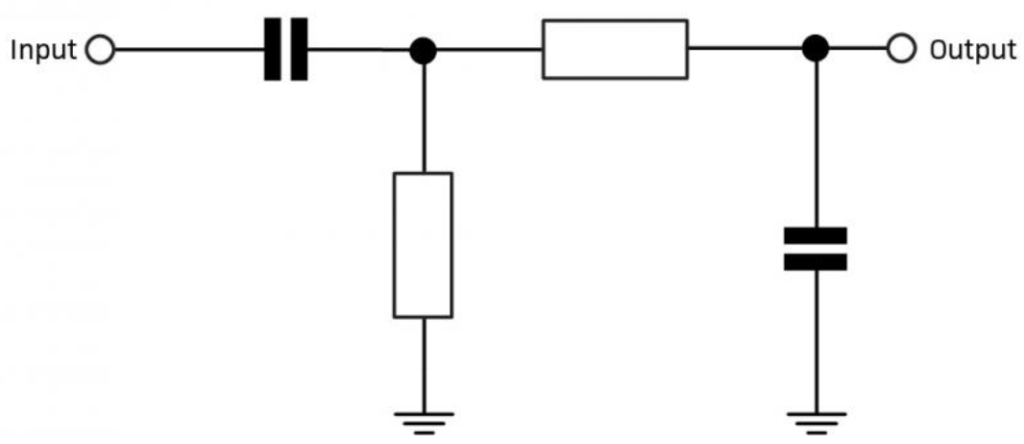
Bandpass filters are a HPF in series with a LPF. Bandstop filters remove a specific frequency.
See the circuit below:
Active Filter
NOWWWW We’re in business!
With the passive filters discussed, there was no amplification. This all changes with active filters.
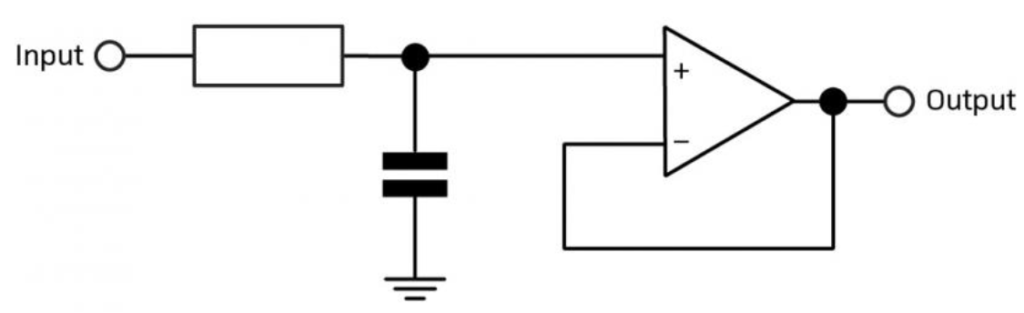
A basic active LPF is shown below. The opamp serves as a buffer to prevent the output loading the RC filter. It is widely used.
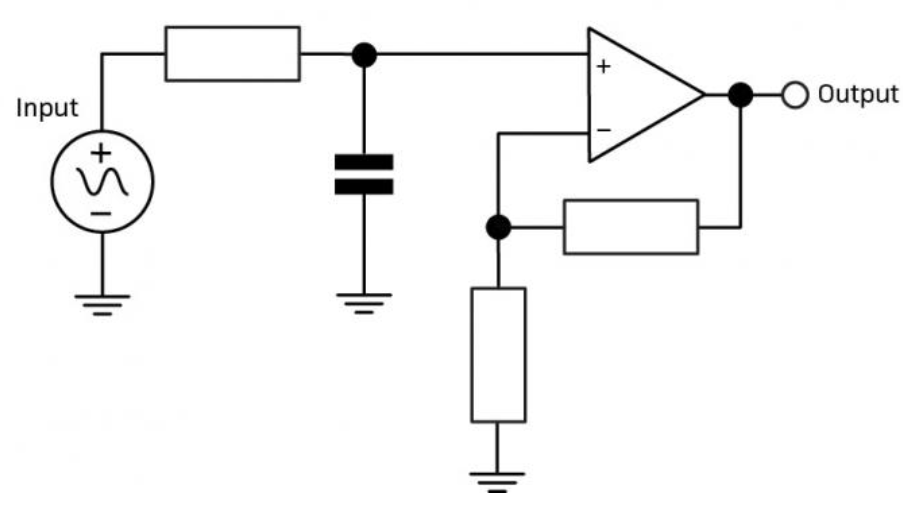
Next, if we add 2 resistors, we introduce gain to the LPF. This is mandatory since signals from sensors are small. An MCU cannot read these small voltages.
Observe the non-inverting opamp circuit below:
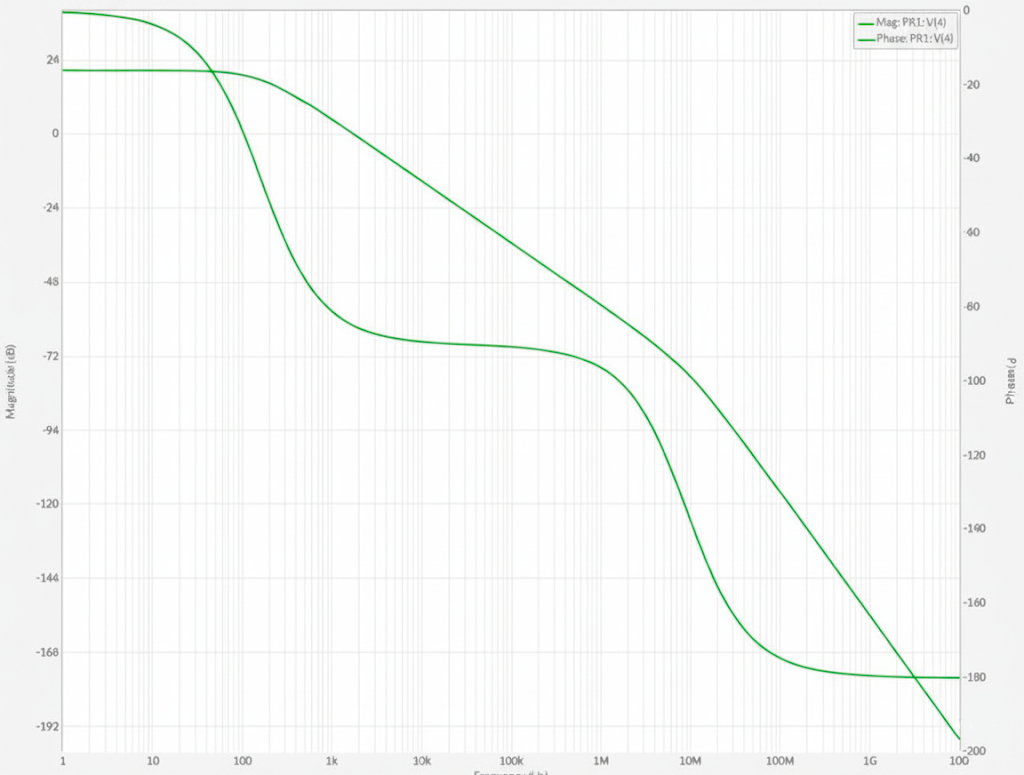
Higher-Order Filters
What about if we want a stronger filter?
Enter higher-order filters. This class of filters is used for stricter filtering, allowing a steeper stopband.
Each additional order improves the response by another 20dB/decade
Also, the cutoff frequency is doubled. We move from -3dB to -6dB.
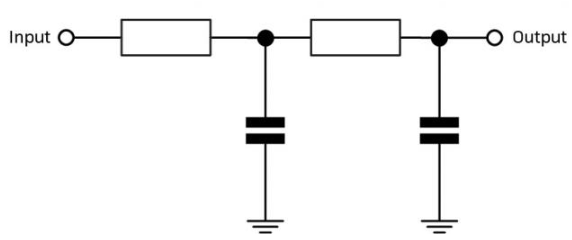
A circuit pictured below can be implemented HOWEVER, the higher order stage will load the previous stage
RLC Filters
Let’s preface this section by examining a simple LC filter and its frequency response. The two reactive components used makes this circuit a second order filter.
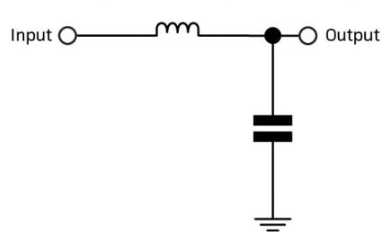
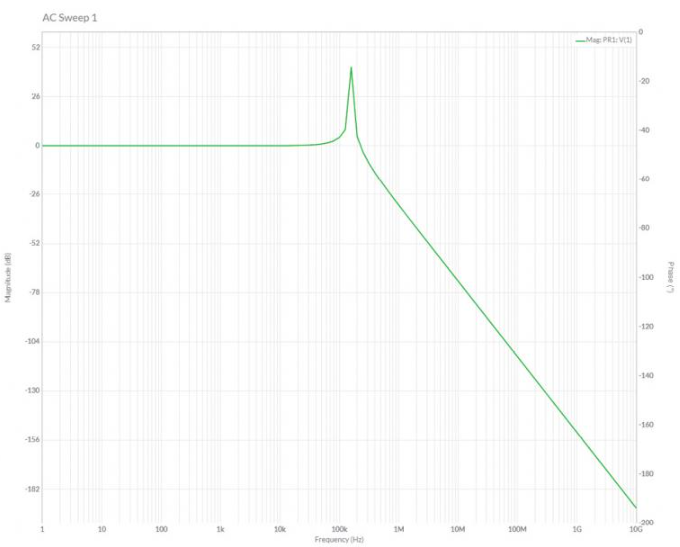
NOTE: This is the ideal case. Any load can literally decimate the resonant frequency. See the simulation below:
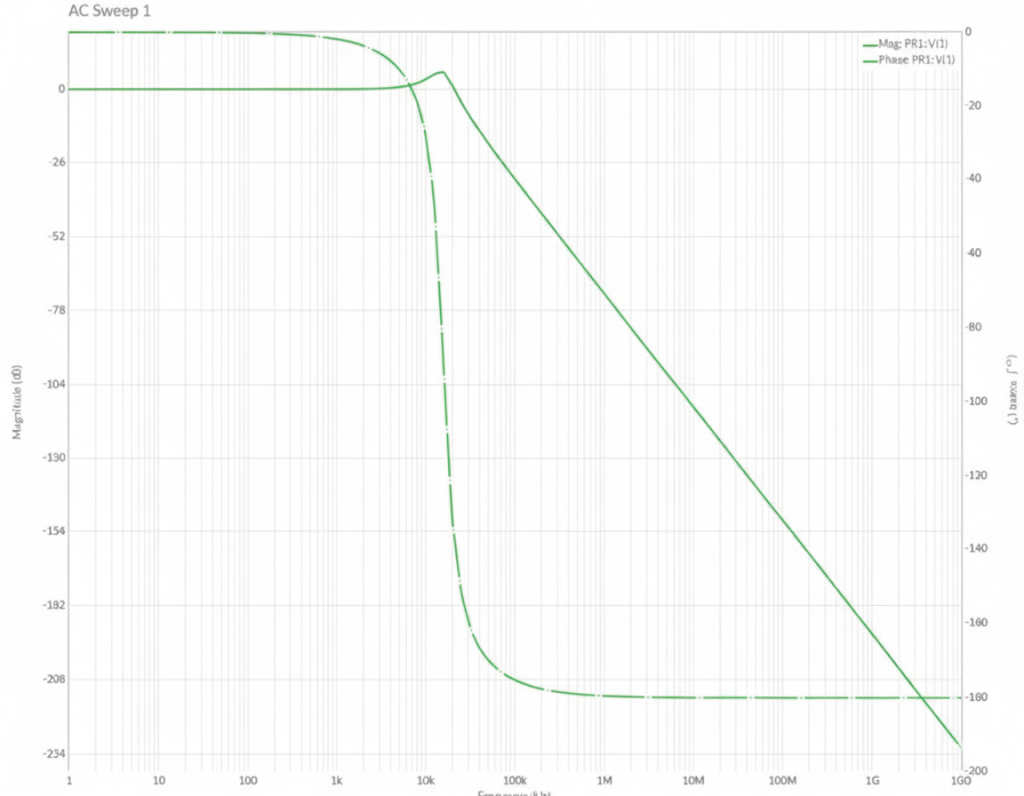
Resonance is classified by the term Q-factor.
Values of Q that are larger than 0.5 mean that the circuit is ‘under-damped’, i.e. the oscillations between the inductor and capacitor occur at least once. Very large values of Q lead to more oscillations, and Q equals infinity theoretically means the circuit will oscillate forever!
A higher Q-factor means greater oscillations
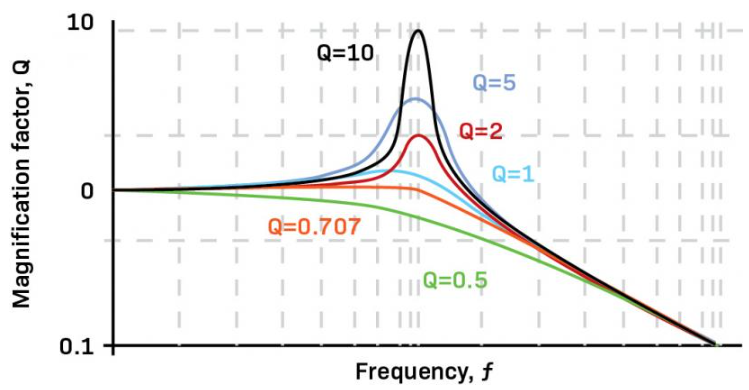
A Q of 0.5 means that the circuit is critically damped.
When designing RLC filters, you design with a particular Q-factor in mind.