Introduction
A majority of mixed-signal systems use ADCs or DACs. These devices use analog and digital components thus require more attention in. Satisfactory circuit design techniques such as routing, decoupling and grounding must be used.
This article will focus on the latter.
Grounding is extensively discussed but can cause significant issues such as degradation of system performance if not done right. While the basics can be comprehended, the implementation is difficult. This is exacerbated by the fact that there isn’t a one-size-fits-all approach to grounding.
This article will examine terminologies, grounding techniques and partitioning methods.
A star-ground configuration is commonly cited but can be difficult to implement and problematic as it causes common-impedance coupling.
Interpreting the AGND and DGND pins
Examine the following pinout of a data converter.
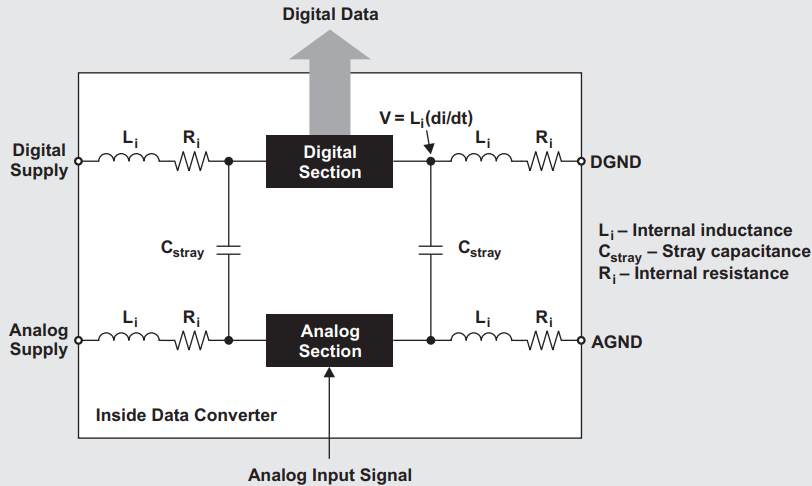
Firstly, to clear the confusion the analog (AGND) and digital (DGND) ground is referencing what’s occurring inside the component, not strictly what a designer should do with the grounds. The datasheet may propose to tie the grounds at the data converter. However, the designer may not want the star to be located in that position.
Whilst we cannot tinker with the internal inductance and resistance, it is advised to join AGND and DGND to a low-impedance ground plane with reduced
Analog or digital ground?
A ground plane/copper pour is a fantastic tool as it behaves as a low-impedance path. It provides the lowest resistance and lowest inductance due to the large, flattened plane. This is particularly desirable for decoupling the high-frequency currents caused by the digital signals. Additionally, it mitigates against external EMI as the ground plan behaves like a shield.
The analog and digital grounds must be separated. That is known. However, should they be connected at the analog or digital ground plane, or maybe even both?
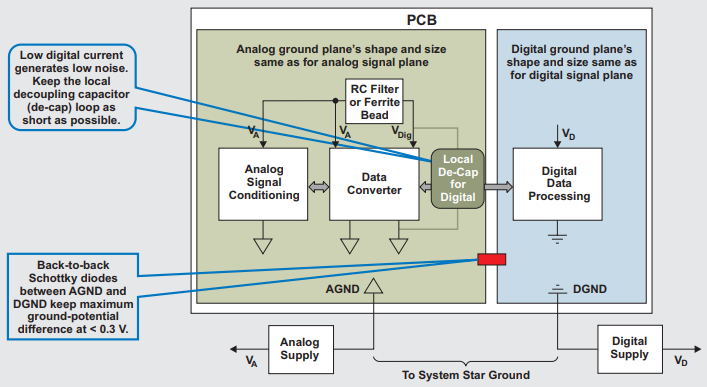
It is advised to connect it to the analog ground plane since a data converter is analog in nature.
A recommended grounding scheme
In this scheme, the analog ground plane is not polluted since the loop area for the decoupling cap is as short as possible. The shape and size of the two grounds should be the same.
A revised grounding scheme
Newer data converters have additional digital circuitry which delivers larger digital currents and noise such as complex filters on a sigma-delta ADC.
In the grounding scheme of Figure 1, if the digital currents are significant, a larger decoupling cap is required. This may not be feasible in some applications. Any digital currents that are not isolated in the small loop will circulate in the analog ground plan, leading to a degradation of system performance.
The grounding scheme must be revised.
The following figure shows a grounding scheme where the data converter evenly shares an analog and digital ground plane. AGND is connected to analog ground, DGND is connected to digital ground. The circuits must be properly isolated.
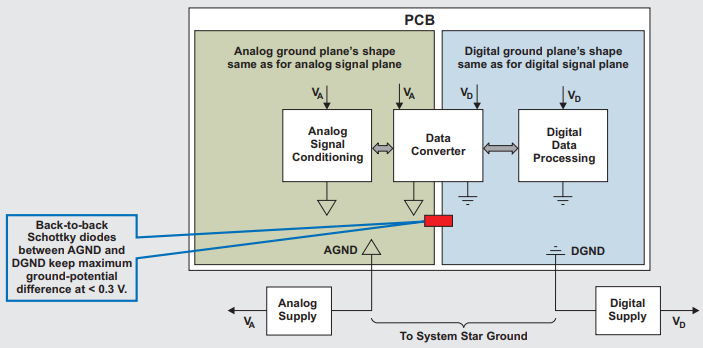
Both schemes implement back-to-back Schottky diodes to connect the two grounds. Their purpose is to prevent significant DC voltages from developing across the planes. A ferrite bead may also be used. It provides a DC connection and filters high-frequency components however, it can introduced undesirable DC ground loops
Isolation or Partitioning
Digital circuitry is noisy. Analog circuitry is vulnerable to noise. How can the two co-exist in harmony?
Splitting the ground plane to isolate DGND from AGND seems proper.
This is problematic.
According to the rules of EMC, the path for return currents should be as small as possible and a system should have one reference plane. The above proposal violates these two rules.
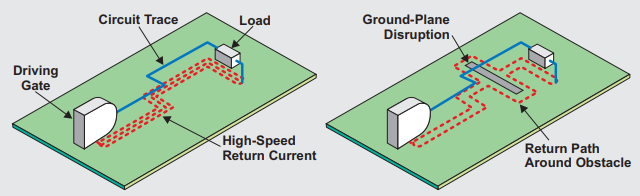
It is important to understand where and how return currents flow. At university, you insert a ground flag and that’s it! Real-life circuits don’t behave like that.
Rather what happens is that the return current follows the path of least impedance (i.e. inductance). Introducing a split in the plane, extends this path. See Figure 4 below. This longer return path causes more EMI and introduces crosstalk.