Introduction
Mobile electronic devices such as phones and tablets provide the PERFECT ENVIRONMENT for ESD hazards (or discharge of static electricity). It occurs when a user’s finger touches the USB or HDMI connector.
This article will discuss ESD protection and the solution.
System-level vs. device-level ESD protection
All devices have device-level ESD protection that provides protection during manufacturing.
Events are simulated by three different device-level models:
- Human body model (HMB)
- Machine Model (MM)
- Charged device model (CDM)
The HBM is intended to mimic ESD events caused by human handling. The MM to mimic ESD events caused by automated handling. The CDM to mimic ESD events caused by product charging/discharging
All of these models differ in terms of test level, pulse width, peak current a 2kV, rise time and number of voltage strikes.
Device level ESD protection is usually specified to survive ESD strike of 2kV HBM or even 500V. This is not enough protection for system-level protection.
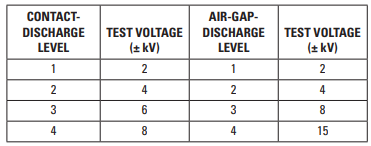
System-level protection i.e. ESD threats from the external environment is defined by IEC 61000-4-2.
There are TWO types of system-level tests specified by IEC:
- Contact discharge
- Air-gap discharge
Introducing the Transient-Voltage Suppressor (TVS)
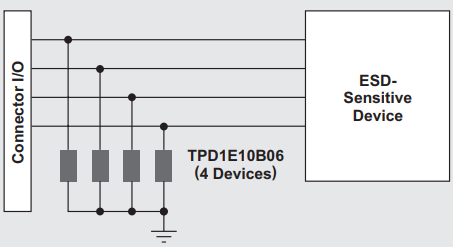
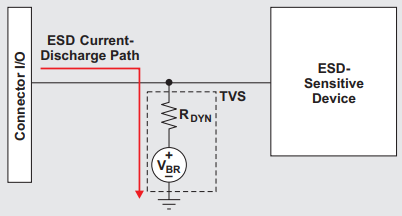
IEC 61000-4-2 specifies using TVS’s for ESD protection. They are positioned in close proximity to the connectors. See Figure 1 below:
There are two types: Bidirectional and unidirectional. Both types are open circuit during normal operation and becomes closed during an ESD event.
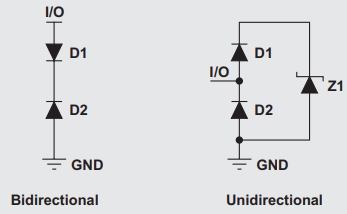
For a bidirectional TVS, in the event of an ESD event, one diode conducts while the other is breaks down, shunting the ESD energy to ground.
For a unidirectional TVS, in the event of a positive ESD event, D1 conducts and Z1 enters the breakdown region. A path to ground is created, thereby shunting the ESD energy. For a negative ESD event, D2 conducts.
Relevant metrics
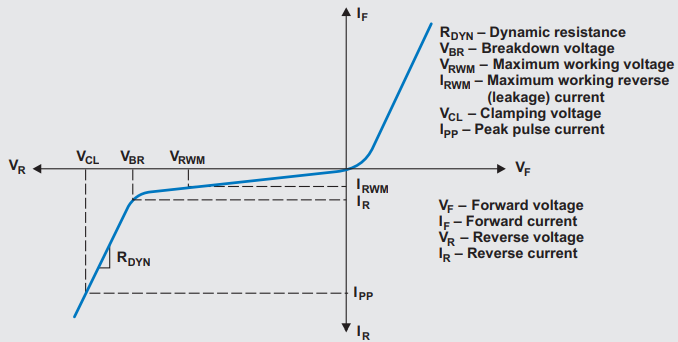
In selecting a TVS, the designer MUST consider:
- Breakdown voltage
- Dynamic resistance
- Clamping voltage
- Capacitance
Breakdown voltage (V_BR)
If TVS must not breakdown within the operating voltage of the system. V_BR should be chosen so that it is a couple of volts higher than the system.
Dynamic resistance (R_DYN)
In ESD event occurs in the nanoseconds range. The time it takes for the TVS to conduct and to shunt the dangerous ESD surge is limited by a resistance called dynamic resistance (R_DYN). It should be 0Ω however <1Ω is acceptable.
Clamping voltage
When an ESD surge consisting of kilovolts is limited, it is clamped to the clamping voltage. This doesn’t occur instantly. See Figure 5 below.
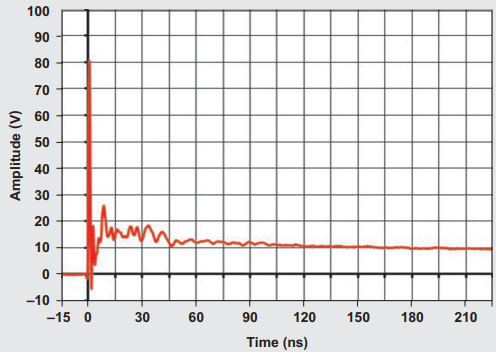
The area under the curve is energy. The better the clamping performance is, the less likely it is that an ESD-sensitive device will be damaged.
Capacitance
During normal operating conditions, the TVS behaves as a short-circuit. There exists parasitic capacitance to ground.
In Closing
ESD events, despite lasting only a couple of nanoseconds can cause irreversible damage to electronic systems. By implementing TVSs, electronic systems can operating safely in the presence of ESD events.