Introduction
Errors in PCB layout can cause poor output voltage regulation, switching jitter and even device failure. Thus, spent time and effort in the PCB layout. This article uses the TPS62130 integrated switch, step-down converter as an example. The internal MOSFETs and integrated loop-compensation circuitry significantly simplifies PCB layout.
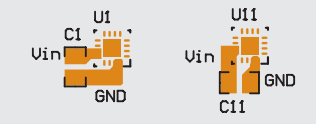
1. The input capacitor
The input capacitor is the SINGLE-MOST IMPORTANT COMPONENT for reliable operation of any step-down converter. Therefore, it should be the FIRST component that is placed. Route it IMMEDIATELY so that nothing else is blocking it.
Extra parasitic inductance between the cap’s terminals, PWR and GND and the pins of the stepdown converter create excessive voltage voltage due to V=L*di/dt.
Place the input cap AS CLOSE AS POSSIBLE to IC supply pins.
2. The switching inductor
The second most important component is the inductor and SW-node snubber (if required).
The latter might be required to mitigate the EMI of SMPSs by slowing down the rise and fall times of the SW node. However, this leads to higher switching losses, reducing efficiency.
The SW-node voltage swings are the main source of EMI in a SMPS.
To achieve EMI reduction, a resistor/capacitor (RC) snubber can be implemented.
Layout the shortest routing path for the snubber, minimizing parasitic capacitance.
To reduce radiated EMI, place the inductor AS CLOSE AS POSSIBLE to the IC.
3. The output capacitor and VOS pin
It is placed to minimize the distance from the inductor back to power ground i.e. the return path. Improper placement causes poor output voltage regulation.
For the BEST OPERATION, keep the loop areas small. DO NOT USE VIAS as they add significant inductance.
An improper or noisy VOS connection causes poor output voltage regulation, switching jitter and even IC failure. Route it now so it has priority. ⚠️
4. Finish up with small-signal components
So far we’ve placed and routed all the components related to power conversion including the input cap, inductor, output cap and optional snubber. Now, the small-signal components enter the picture.
These include the FB pin voltage divider, soft-start cap and decoupling caps.
The analog small-signal components are sensitive to noise.
Therefore, place it as close as possible to the IC with short routing to keep their noise sensitivity LOW. The FB node has to be AS SMALL AS POSSIBLE to minimize noise pickup and to ensure good output regulation.
Any digital signals such as EN and PG pin circuitry are the LEAST IMPORTANT. Digital pins typically have a low impedance driving source.
Pullup/pulldown resistors can be placed anywhere.
5. Create a common ground
Follow the datasheet.
Generally, this means one ground for power components (this will be noisy) and another for the small-signal components (which are quiet).
Connect it at a single point under the exposed thermal pad UNDER the IC.
Connecting the grounds provides the best thermal relief
Position vias UNDER the IC for heat dissipation
And remember, ALWAYS CONSULT THE DATASHEET