Introduction
The war of linear vs. switched-mode power supplies rages on!
Each configuration is better suited to meet a specific application. Developing an understanding of this allows designers to select one over the other.
Background
The electrical grid uses AC voltage to step up and step down voltages as it’s easier and more efficient. For applications that require the supply voltage to be stepped down, a linear power supply (PSU), did the trick. This involves a transformer stepping down the input voltage. It is then rectified then regulated to provide a useable DC voltage.
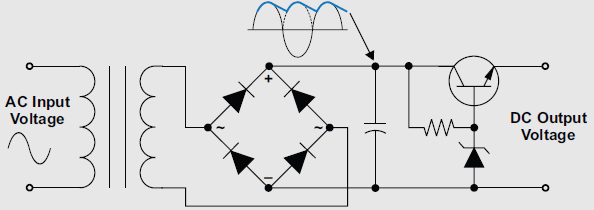
Using linear regulators was widespread until the 1960s/70s rolled around. Suddenly, semiconductor switches were developed that could switch in the kHz speed. This allowed a significant reduction in the size of the transformer and resulted in significant improvements in efficiency.
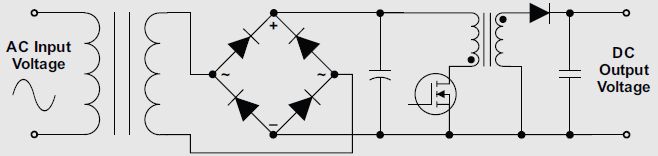
Let’s now compare the two topologies to gauge their strengths and weaknesses
1. Input voltage range
The SMPS is the clear winner in this category. It can suit input voltages from 85VAC – 265VAC simply by adjusting the duty cycle of the switch. This makes it applicable to use anywhere in the world. Linear PSU’s on the other hand are designed for a particular grid voltage (e.g. 230V in Europe). An internal hardware switch allows the input voltage to be changed however this is less convenient.
For a linear PSU, if V_in falls more than 10%, V_OUT falls regulation.
2. Efficiency at light-load
The high volt-seconds of the transformer for a linear PSU, causes a large magnetizing current to circulate which causes significant power losses even at light and no-load conditions.
In contrast, a SMPS has a smaller magnetizing current due to the smaller volt-seconds. Additionally, as the load reduces, the duty cycle reduces, thus further reducing switching losses.
3. EMI Considerations
This is the one category, where linear PSU’s have the a significant advantage.
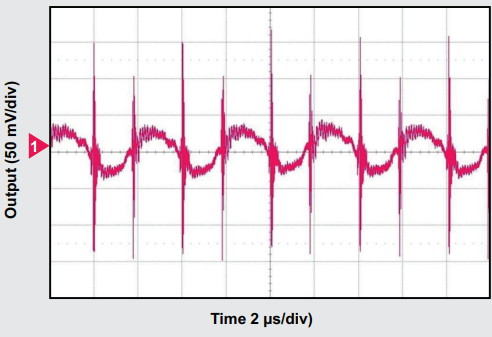
The high-frequency switching of a SMPS generates significant EMI and causes a ripple (50mV typical) at the output. See Figure 3 below. Linear PSU’s are inherently quieter.
The conducted and radiated emissions are mitigated using appropriate filtering and shielding, thereby reducing the undesirability of this drawback.
4. Transient Response
Transient response refers to how quickly a PSU can respond to changes in the load.
Linear PSU’s have a superior transient response. The feedback loop and presence of passive components located in the power stage of a SMPS results in poorer transient response.
Conclusion
The table review summarizes the comparison of the two major types of PSU’s.
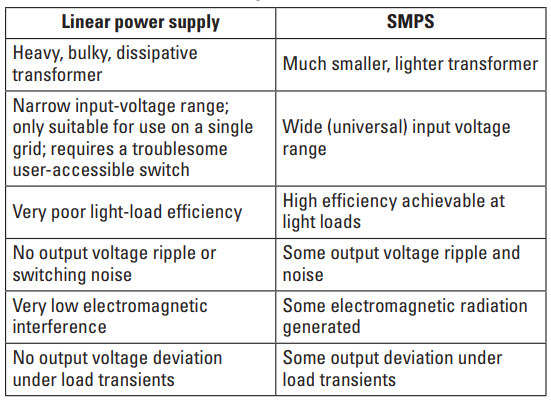
Despite the obvious drawback of EMI for SMPS, they are still more ubiquitous than their linear counterparts due to their reduced size, weight and greater efficiency. Also, filtering and shielding mitigates the conducted and radiated emissions