Introduction
When we build circuits, ideally we want them to survive under a range of load conditions. This is the purpose of circuit protection.
This article will cover various methods of circuit protection and outline their pros and cons.
Also, this article will cover reverse polarity, short-circuiting, overcurrenting, voltage surges and under-voltaging.
Using Diodes
A note on reverse polarity. It isn’t confined to reversing the battery connections at the input. It can also occur through voltage spikes from inductive loads such as motors.
The BIGGEST DISADVANTAGE is the voltage drop.
For low-power applications, it is simply not feasible.
Consider a 5V USB supply. It will drop to 4.3V. Plus, it will drop further when the load current increases. @3A a drop of 0.7V generates 2.1W of power loss
Schottky diodes can be used as they have a lower forward voltage drop of 0.2-0.45V. Also, Schottky diodes have delays of a few tens of nanoseconds making them suitable in high-frequency applications
The PN junctions of diodes have some parasitic capacitance which delays the switch from non-conducting to conducting when reverse-biasing has been removed. For DC-DC converters such as buck and boost this can be problematic.
The Bridge Rectifier
This circuit is commonly used to convert AC to DC however it can be used as reverse polarity protection. if you don’t mind 4 diode voltage drops.
MOSFETs
Unlike transistors, FETs are voltage-controlled switches.
When selecting a FET, consider the following:
- R_DS. This determines the voltage drop
- VGS. This is the voltage rating of the FET
- VGmax
- Vthreshold
They come in N-channel and P-Channel variations. The pinout differs. See below
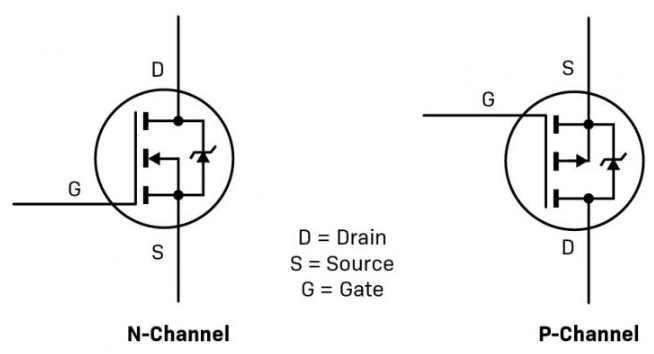
FETs have been replacing diodes in many applications due to their significant current capabilities, low RDS on and rapid switching. FETs have replaced diodes in DC-DC converters. This is called synchronous rectification.
NOTE: FETs are fragile due to a gate capacitance
When designing a circuit, ensure the gate is pulled down to ground (with a pulldown resistor) to prevent erratic behavior from a floating gate voltage
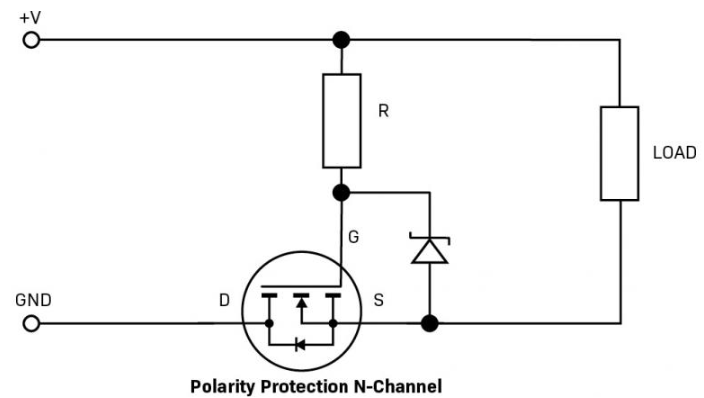
N-channel FETs are used as low-side switches. A positive V_GS causes the FET to conduct. This implementation can be problematic due to multiple ground paths
P-channel FETs are used as high-side switches. A P-channel FET conducts with a negative VGS.
The P-channel circuit is recommended as there exists less connections from the supply to the load then from the load to ground. This eliminates the potential issue of alternative paths to ground not being protected.
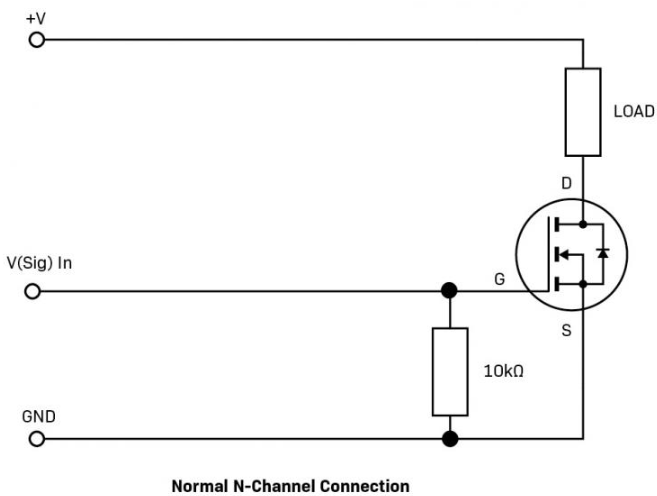
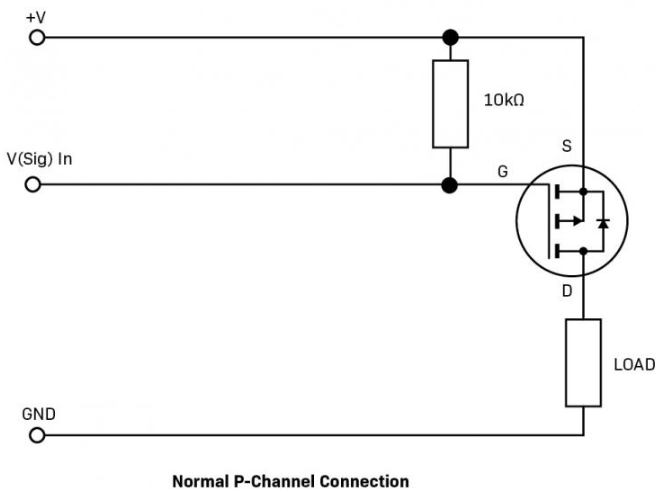
In the following circuit, if polarity is reversed, the FET switches off since it’s reverse-biased. The Zener and resistor limit the V_G to a safe level
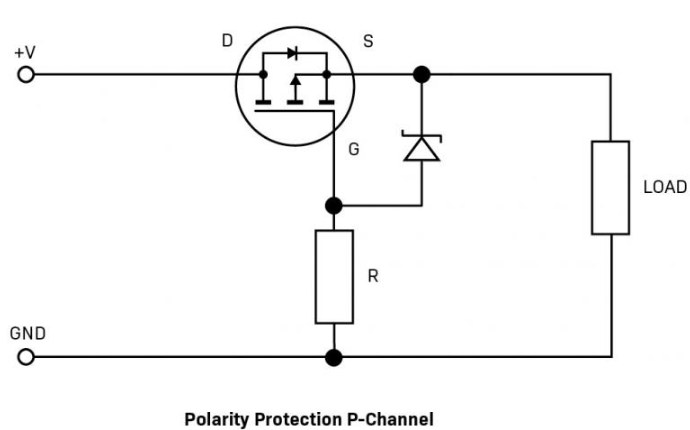
The N-channel equivalent circuit is shown below:
The threshold voltage is the voltage that the MOSFET begins conducting however it’s not fully conducting until its more than V_threshold. E.g. V_threshold = 4V but full conduction occurs at 10V