Introduction
We take a look at one of the most powerful and widely-used building blocks in electronics.
They can be configured to perform a WIDE number of tasks.
If you don’t believe me, take a look below at an excerpt from the application notes from George Philbrick who commercialized the first opamp in the 50s:
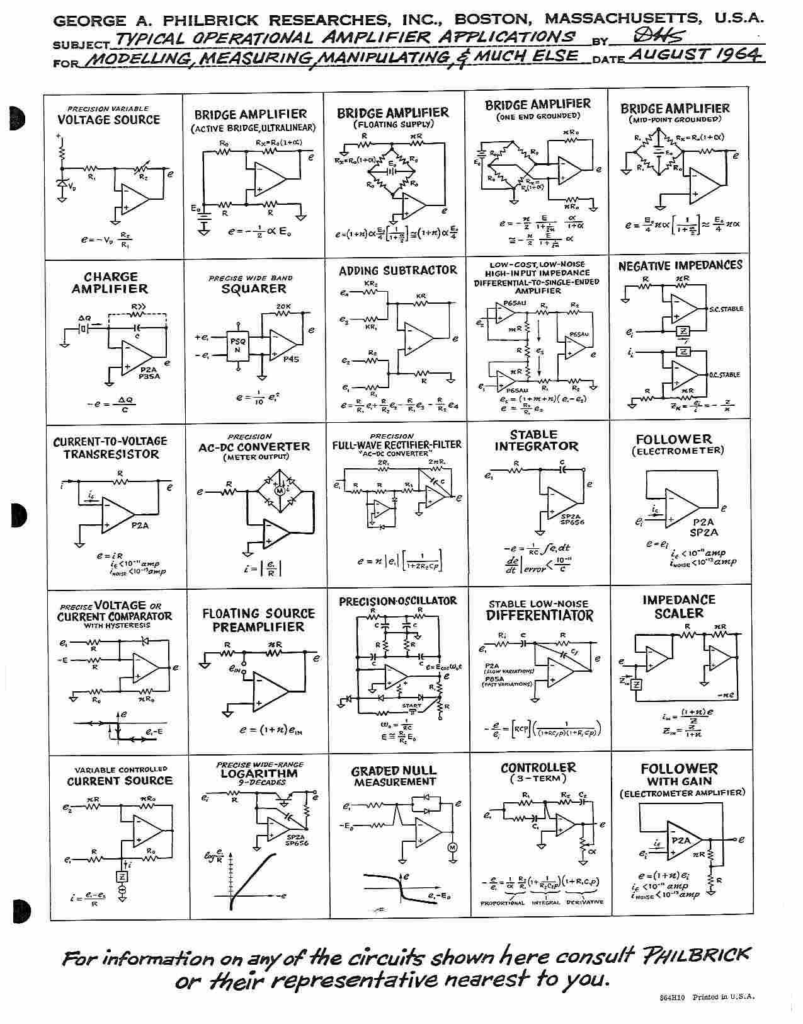
The op-amp performs many mathematical operations such as differentiation, integration, multiplication, division, addition and subtraction. Hence, it’s name operational amplifier.
Since all electronic circuits can be reduced to mathematical functions, op-amps can manipulate them. E.g. a sawtooth generator is an integrator and an amplifier is a multiplier.
An opamp has 5 IDEAL characteristics:
- Infinite bandwidth
- Infinite input impedance
- Zero output impedance
- Infinite open loop gain
- Zero output voltage if input voltage is zero
If used with no feedback, the opamp is operating in open loop mode 💡
Understanding the opamp featuring the LM741
In terms of the schematic symbol, there is the triangle and the normal 8-pin DIP.
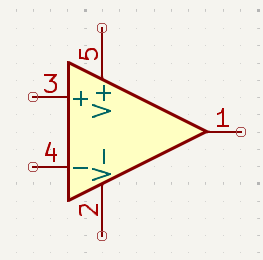
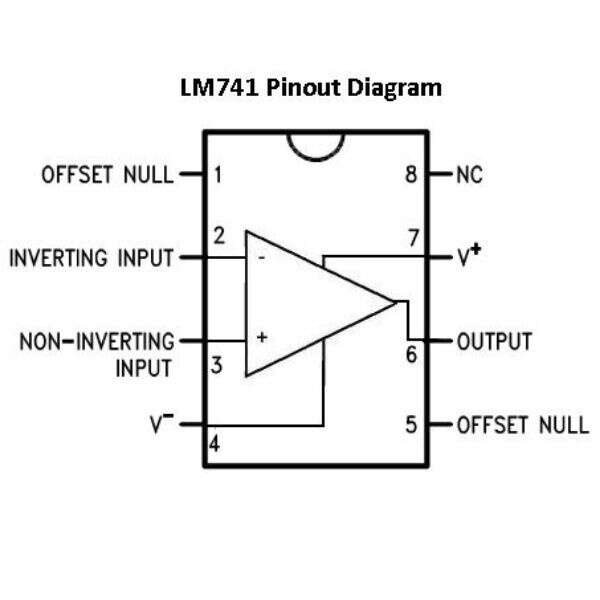
NOTE: You can purchase IC’s that have two or four opamps in a single package such as the TL072 and TL074
The explanation of the pinout is self-explanatory.
Let’s examine a common opamp – the LM741.
For the LM741, the power supply is +/- 22V.
The input voltage is +/- 15V.
The open-loop gain is 200,000. Ideally it’s infinity.
The gain bandwidth product (GBWP) is a specification that means that the gain will drop as frequency increases. The GBWP for the LM741 is 1MHz. This means at 1MHz, the gain is 1:1. At 100kHz, the gain is 10, and 100, it will be 100 etc.
Newer opamps have a GBWP in the GHz range, giving them the widest possible bandwidth.
The input impedance is 2 Megaohms. Ideally its infinite.
The output impedance is approximately zero.
Now, let’s take a look at 5 common applications:
1. Non-inverting Amplifier
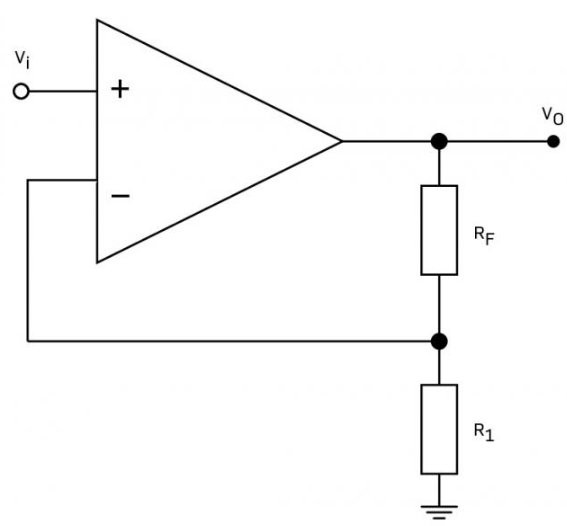
Voltage gain, Av = 1 + Rf/R1
Output is in phase with the input since input is applied to the non-inverting input
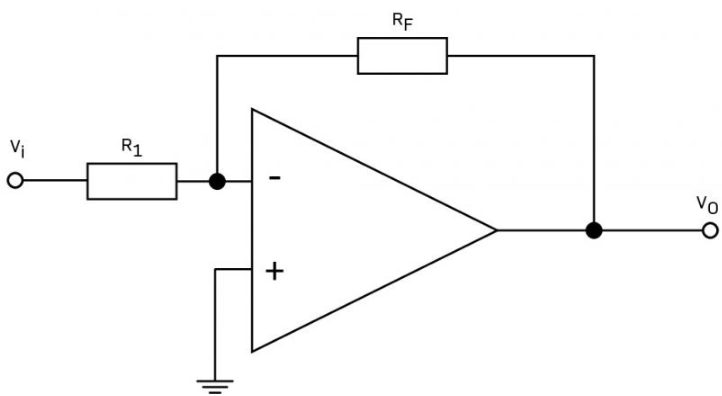
2. Inverting Amplifier
\begin{aligned}
V_{o} &= -\frac{R_{f}}{R_{1}} V_{i} \\
A_{v} &= -\frac{R_{f}}{R_{1}}
\end{aligned}
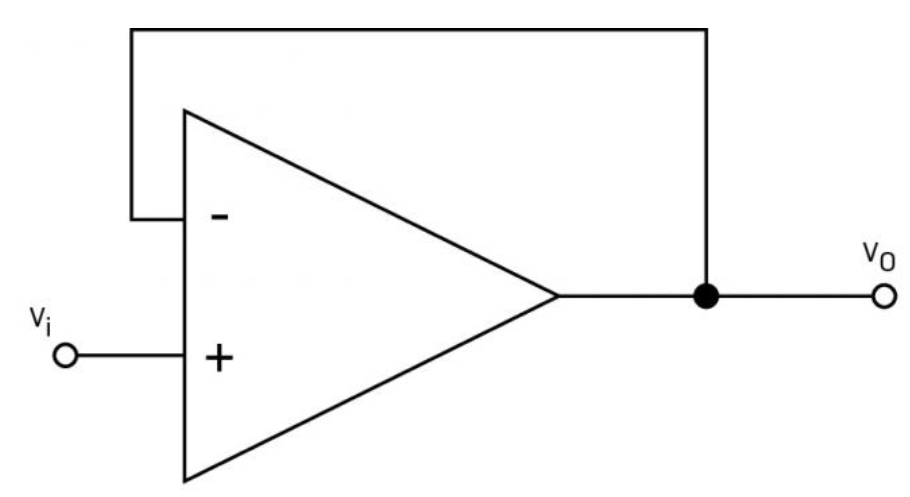
3. Voltage Follower
4. Summing Amplifier
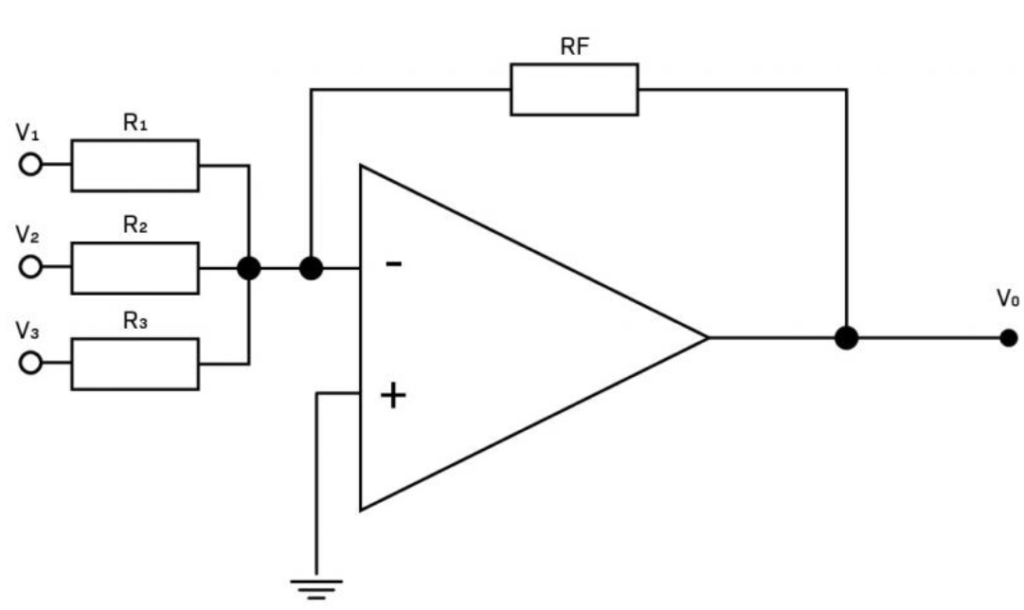
Similar to inverting amplifier except we have R2 and R3
V_{o} = -\left(\frac{R_{f}}{R_{1}} V_{1} + \frac{R_{f}}{R_{2}} V_{2} + \frac{R_{f}}{R_{3}} V_{3}\right)
If R1 = R2 = R3 = Rf,
Vo = - [V1 + V2 + V3]
If R1 = R2 = R3 = 3*Rf, the circuit gives the average of the inputs
V_{o} = \frac{1}{3}\left(V_{1} + V_{2} + V_{3}\right)
5. Difference Amplifier
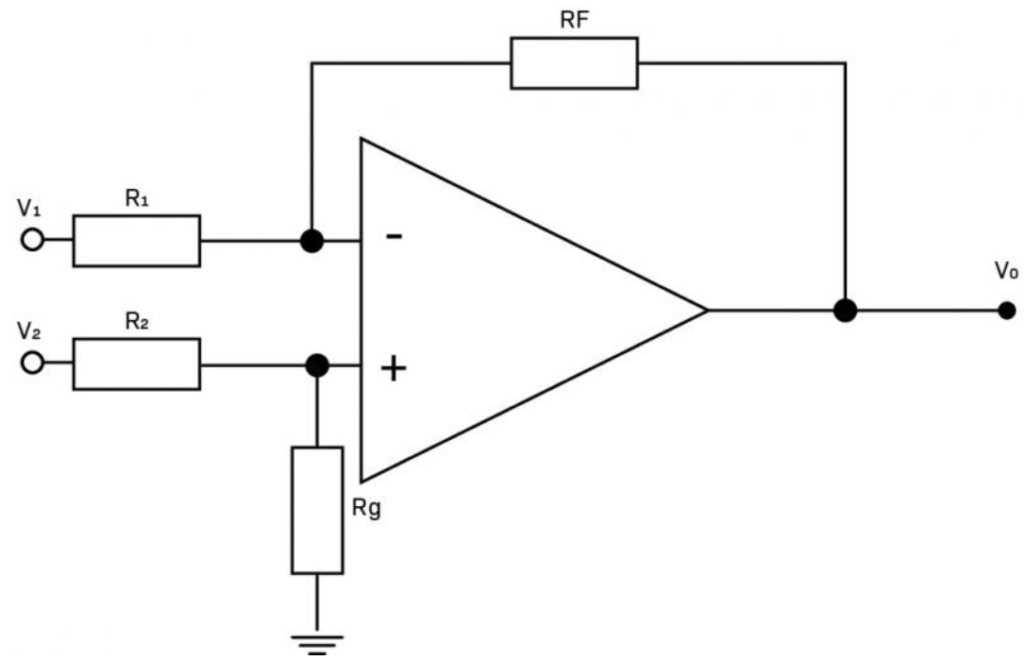
V_{o} = -\frac{R_{f}}{R_{1}} V_{1} + \left(\frac{R_{g}}{R_{2}+R_{g}} \cdot \frac{R_{1}+R_{f}}{R_{1}}\right) V_{2}
If R1 = R2 = Rg, then
Vo = V2 – V1 (assuming zero tolerance on resistors)
\text{If } R_{f} = A R_{1}, \; R_{g} = A R_{2}, \; R_{1} = R_{2}, \text{ then:} \\[6pt]
V_{o} = A \left(V_{2} - V_{1}\right) = \frac{R_{f}}{R_{1}}\left(V_{2} - V_{1}\right)
BONUS: Hands-on application
To reinforce our understanding, let’s look at an opamp application.
Let’s say we want to amplify the output of an electret microphone, which is 20mV to 1V.
A non-inverting amplifier with feedback will do the trick.
The required gain is 1V/20mV = 50.
We can use a 5V supply with a voltage divider to drop it to 2.5V.
For a non-inverting amplifier, the gain =
1 + Rf/Ri
If we select Ri = 1k, Rf = 49k.