This article explains how the 74HC595 reduces I/O-pin usage by converting serial data into 8 parallel outputs with a built-in D-type storage (output) register and high-current CMOS outputs. You clock bits in via SER and SRCLK, then latch all eight outputs simultaneously with RCLK, which cleanly updates LED or 7-segment displays. Also, using a shift register simplifies the code
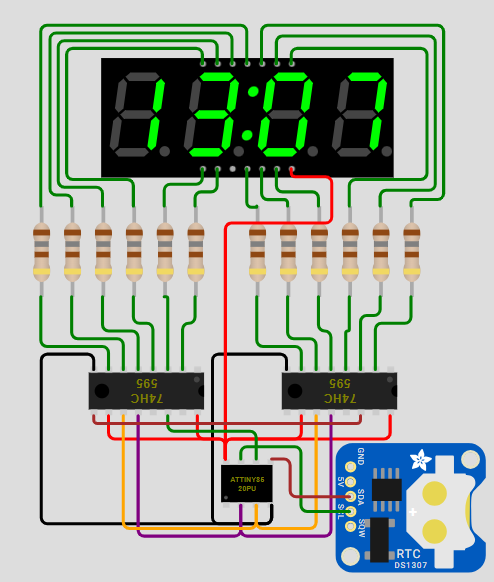
Introduction
The 74HC595 is widely used to expand I/O’s and is frequently used to drive 7-segment displays. Let’s learn more.
The 74HC595 is a 8-bit serial-in, parallel-out shift register with a 8-bit D-type storage register. It accepts a serial stream then shifts the bits into a storage register. Once latched, this information is shifted to a parallel 8-bit output.
The 8-bit D-type storage register retains the value of the bits during power-down or if SRCLR (shift register clear) is pulled low.
Understanding the pinout
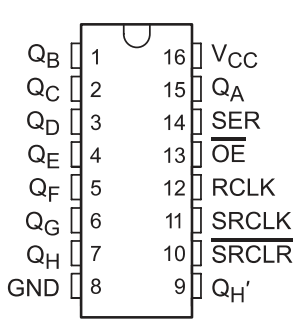
QA – QH are the eight outputs.
Pin 11 = SRCLK = Shift Register Clock
This pin controls the timing of data transfer into the shift register. Every positive-edge pulse, shifts a bit into the register
Pin 12 = RCLK = Register Latch
When high, it sends the bits to the output pins
Pin 14 = SER = Serial Data Input
This pin accepts data in a serial format.
These 3 control pins can be controlled with an Arduino program.
The 74HC595 will accept a serial bitstream on pin 14 and shift them on the rising edge of SRLCK (pin 11). Once all the bits have been shifted in, triggering RLCK (pin 12) converts the serial input into a parallel output.
Other Pins
Pin 13 = Output Enable
This enables the parallel outputs when pulled low
Pin 10 = SRCLR = Shift Register Clear
This clears the contents of the shift register.
What about pin 9?
Pin 9 allows you to cascade multiple 74HC595’s.
Once the first one is full, the data overflows to the second shift register.
The powerful thing is that if we decide to cascade 50 74HC595’s for whatever reason, we still use the 3 same control pins, SRCLK, RCLK and SER. Talk about leverage!
In Closing
Using a 74HC595 allows you to outsource majority of the legwork required in programming a 7-segment display (a popular example). It frees up I/O’s, which can be scarce in space-limited applications and simplifies the programming.