This series will focus on designing a linear bench power supply safely and correctly, from mains-in to rectification and smoothing.
Part 1 will discuss the characteristics of a linear PUS, rectification and capacitive filtering. Part 2 will add regulation and the protection stages
Disclaimer: A person legally cannot work on voltage above 50VAC with an electrical license. You have been warned
Characteristics of a Linear Power Supply (PSU)
A AC-DC linear PSU converts an AC voltage into a DC voltage suitable for us by various electronic loads.
The conversion process is as follows:
- A stepdown transformer will … reduce AC voltage
- AC voltage gets rectified to DC
- This DC voltage is smoothed out by capacitors
- That’s it
Other features include:
- Adding regulation to the output
- Overvoltage protection
- Fused input
- Overcurrent protection
- Isolation switch
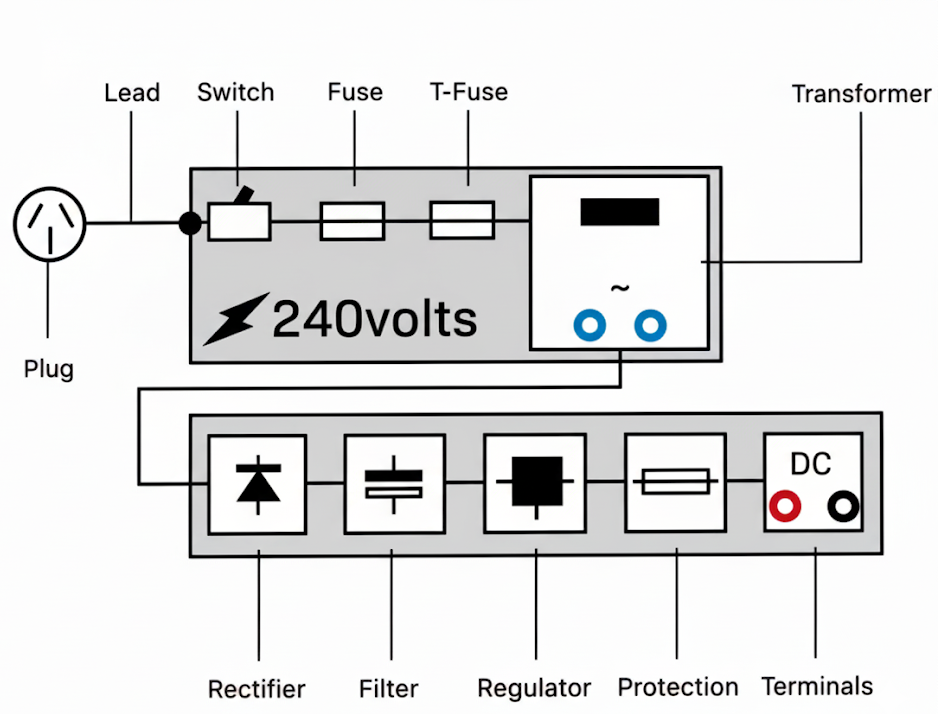
We will now discuss each stage.
1. AC Rectification
An Australian General Purpose Outlet (GPO) provides 240VAC. So what is the DC equivalent?
VDC_peak = VAC * squareroot 2 – 2*0.7V (diode drop)
The above assumes full-wave rectification
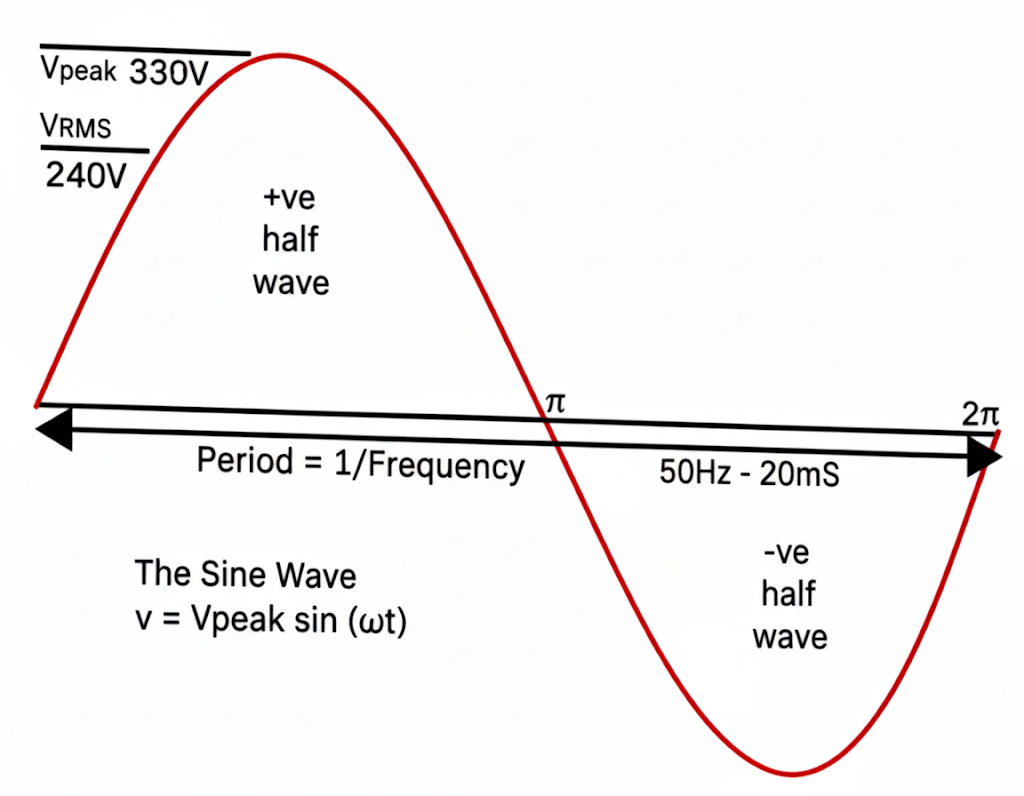
Half-wave rectification
Half-wave rectification provides VDC = 0.45*Vrms – 0.6V
The 0.6V is the diode drop
Full-wave rectification
To increase the output voltage, we can capture both cycles of an AC sine wave by using full-wave rectification.
This means capturing the negative wave of the AC signal. See the image above which depicts an AC sine wave.
Employing this method allows us to double out output voltage however we also introduce 3 more diode drops
A trick
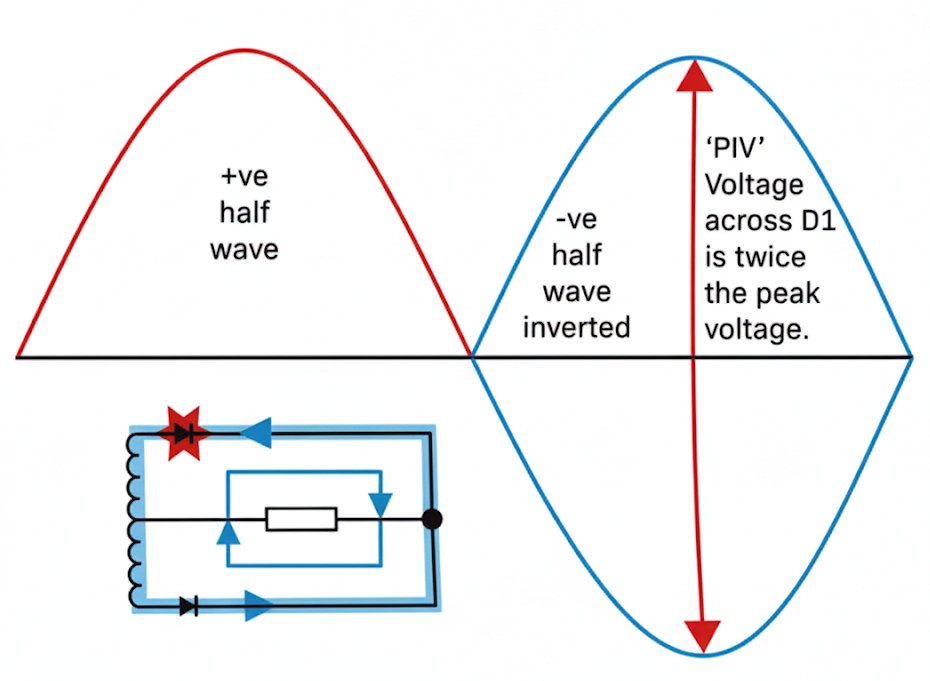
If we use a centre-tapped transformer, we can reduce the amount of diodes required to two whilst still performing full-wave rectification.
However, diodes with a higher reverse voltage rating are required. This is because when one winding conducts via one diode, the peak voltage of both windings briefly appears on the nonconducting diode. Thus, the Peak Inverse Voltage (PIV) of the diodes must be TWICE that required by the bridge circuit.
Filtering (Smoothing)
The rectified AC isn’t exactly a DC signal. It is composed of half waves. The next step is to convert this into a straight DC signal. This is the purpose of filtering/smoothing.
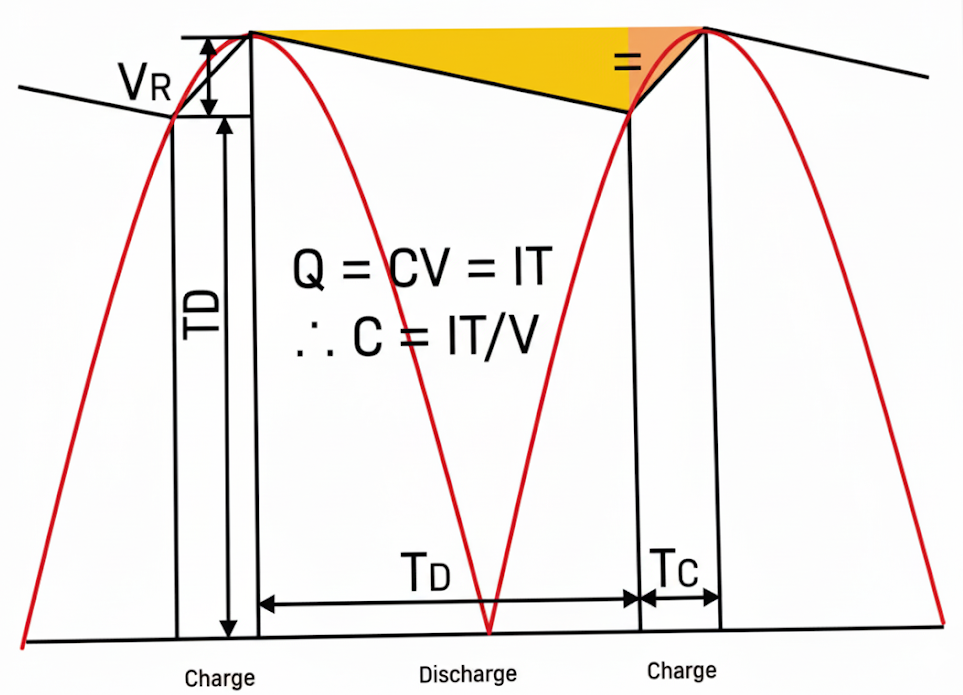
Ideally, the capacitor should supply the entire load current for the whole period of the half-cycle AND recharge itself. This requires infinite capacitance therefore, their will always be output ripple V_R. The size of the capacitance is inversely proportional to the ripple voltage. Keep this is mind when considering your appetite for low ripple voltage.
Q = CV = IT
C = IT/Vr
I = load current
T = period of current flow. This is 10mS assuming 50Hz.
Vr = Ripple voltage
Vr = IT/C
For example, for a linear PSU supplying 1A at 1V ripple,
C = (1) * (0.01) / 1 = 10,000uF
NOTE: This is a rule of thumb