Welcome to this two-part series of discussing switch-mode power supplies (SMPS). Part 1 will introduce the different blocks of a SMPS and the core topologies (buck, boost, buck-boost)
Introduction
Linear PSU’s are a thing however everything changed with the 1960s space race. Suddenly there was an urgent need for PSU’s to be light and efficient. Linear PSU’s despite their simplicity and low cost couldn’t cut it. Linear PSU’s also cannot generate an output voltage greater than the input voltage
And what a catalyst that was!
Without the development of Switchmode Power Supplies, your phone charger would be about 10 times heavier, many times larger and probably more expensive too.

In terms of size, the transformer is the largest component in a linear PSU. They are sized to operate off 50Hz.
Using Wt = 3*VA/f, where
Wt = weight of iron core transformer
Given a 12V supply delivering 20A, Wt = 3(20)(12)/50 = 14.5 pounds or 5.6kg of iron alone for the transformer.
For a space application, this is simply not feasible
The major difference between a linear and switched PSU is use of a switching element to control the pass transistor.
Smoothing Cap
The size of the smoothing cap obeys the following formula:
C = IT/V, where
- I = load current
- T = charge time
- V = ripple voltage
For a 1A load, say we want V_ripple of 0.1V for a 50Hz switching rate, C = (1A)(10E-3s)/0.1V = 100,000uF
That is a significant capacitor value!
However, if we increase the switching frequency, the capacitance decreases. E.g. for 50kHz, the capacitance decreases to:
C = (1)(10E-6s)/0.1V = 100uF
1000x the frequency reduces the capacitance by 1000x
THIS is first big advantage of a SMPS. It allows you to reduce the size and weight of the PSU.
The Switcher
Mainly MOSFET’s are used to drive the pass transistor.
BJT’s are current-controlled devices. The base current is proportional to the load current. This means that the BE junction losses can be significant, resulting in additional losses.
Since MOSFET’s are voltage-controlled devices these losses aren’t present. Also, they can be controlled from a simple driver IC.
In almost all cases, leakage current when the switch is off is insignificant.
Faster switching increases switching losses. Although, this reduces the capacitance and weight.
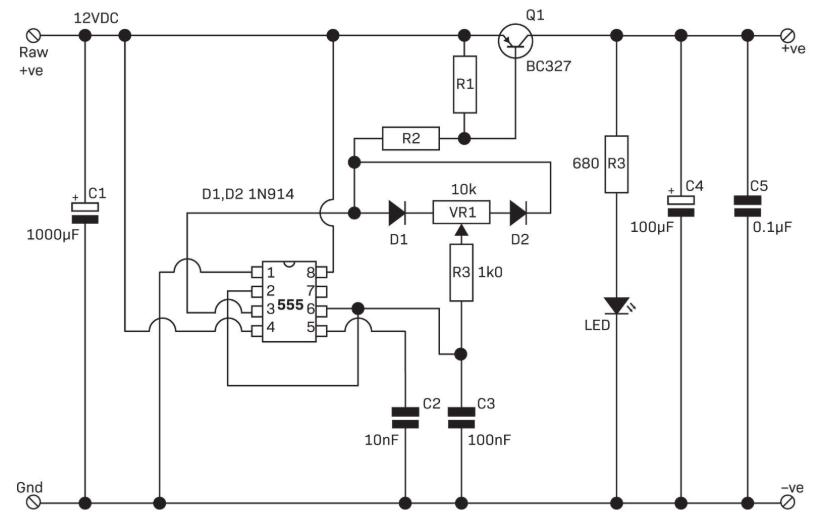
PWM
The simplest SMPS is a PWM control. Although, we’ve simply switched the load supply on and off without regulating the output.
For a variable voltage, non-regulated variable DC supply, the following circuit can be used to control a small motor via PWM.
NOTE: This circuit doesn’t include a flyback diode to absorb the back emf. Ensure you add it
Buck
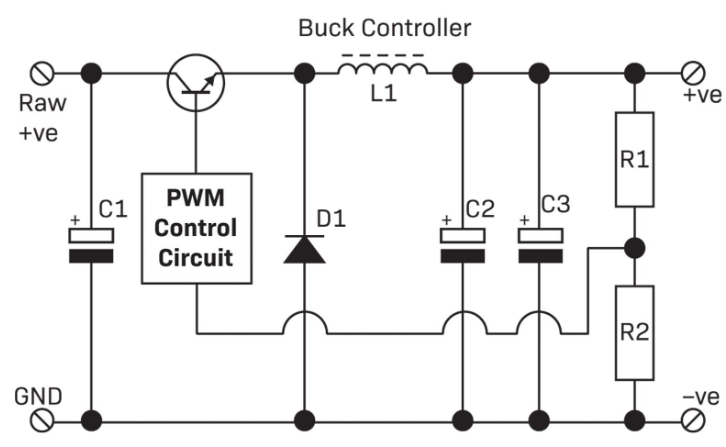
The capacitors (C2 and C3) ensures a voltage at the output when there is no load. This is vital as the inductor cannot smooth voltage, only current.
NOTE: Some designs require a minimum load current to allow regulation, and therefore a resistor may be required across the terminals to provide that minimum load.
The diode (D1) is a freewheeling diode that conducts when switch is OFF. This avoids high voltages generating when the magnetic field of the inductor collapses.
Boost
A boost converter is very similar to a buck topology. The difference is the location of the inductor, diode and pass FET are different.
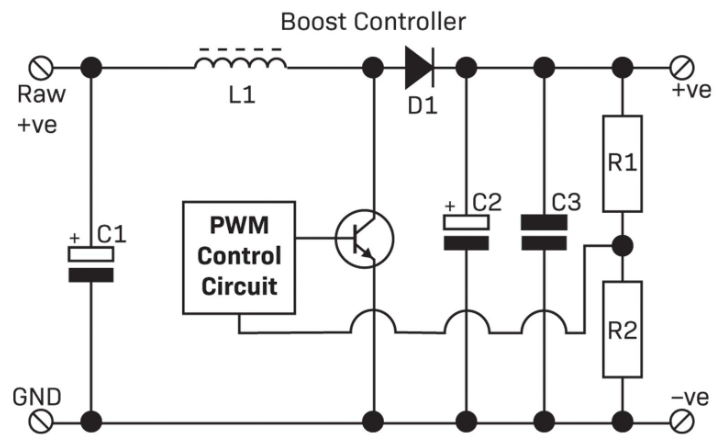
When the switch is OFF, the load has the same voltage as the supply as C2 and C3 charges upto the supply voltage. When the switch closes, the capacitor supplies the entire current to the load
The voltage across the inductor will be the full supply voltage.
When switch OPENs, current from inductor travels to load. If the switching is fast enough, and the load current low enough (both factors involved in the design process), then the voltage across the load will remain at a value above the supply voltage
Buck-Boost
A buck-boost converter provides an output voltage either lower or higher than the input voltage. However, it’s polarity is inverted.
If you seek the same polarity, consider a SEPIC converter. This topology can offer a lower or higher output voltage with the same polarity as the input voltage.
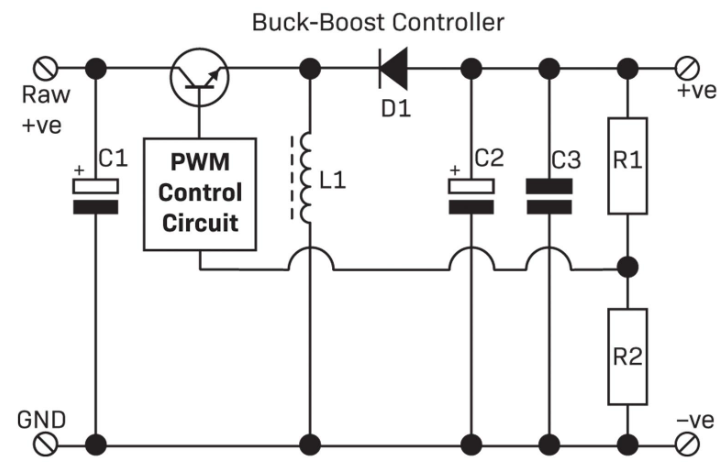
When the switch is closed, the inductor L1 begins to charge up. D1 prevents current from reaching the load.
When the switch is open, the inductor current cannot instantly change. Thus, it flows through the caps and the diode.