This project pushes the boundaries of an LED.
It mimics a strobe light. Strobe lights are used on the Harbor Bridge, airplane runways, construction towers, military and hiking.
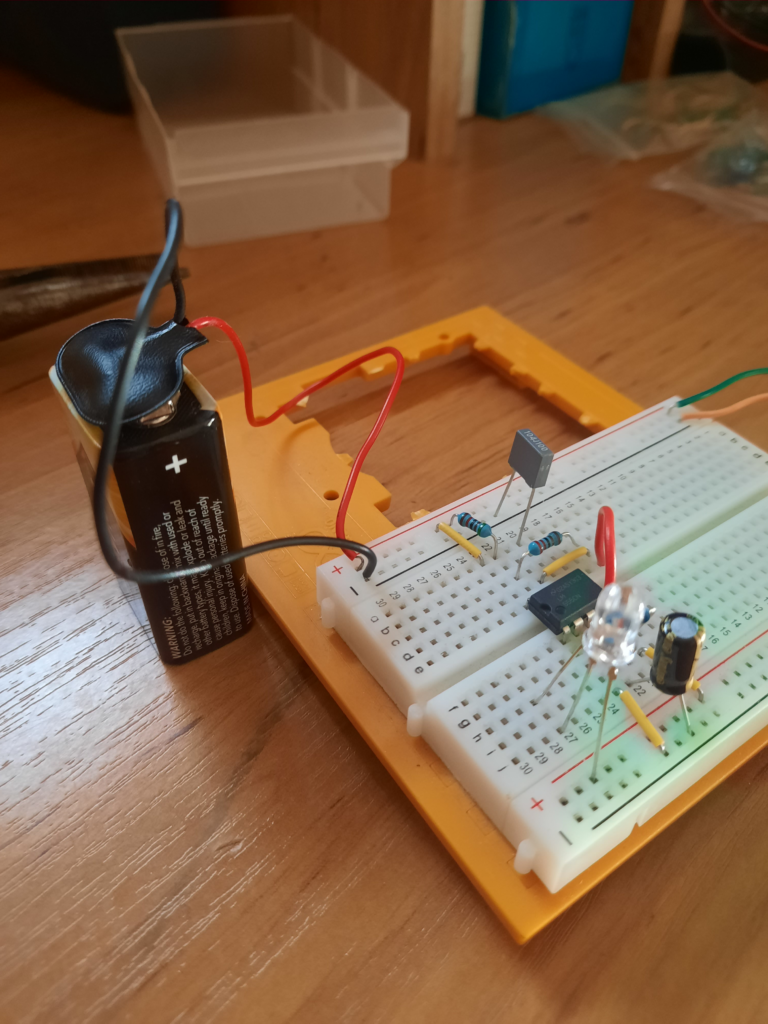
The circuit uses the 555 in astable mode (rather than monostable). In this configuration, the 555 toggles itself repeatedly.
In the schematic, the cathode of the LED is connected to pin 3 (OUT) of the 555. You can connect it to this pin in addition to ground as the 555 can sink 200mA of current.
All LEDs have a forward voltage & forward current but this is for continuous operation and to extend the lifespan of the LED, which is 100,000. If we exceed it, we’ll diminish the lifespan to 10,000 which isn’t the end of the world. The tradeoff is more brightness which is always welcome. In this circuit, Ohm’s law will be used to calculate the required current-limiting resistor to deliver 100mA to the LED
R = \frac{V_{\text{supply}} - V_{\text{LED}}}{I_{\text{forward}}}
A few notes for the schematic:
- I use the zigzag symbol (rather than the rectangle) for the resistors
Circuit Operation
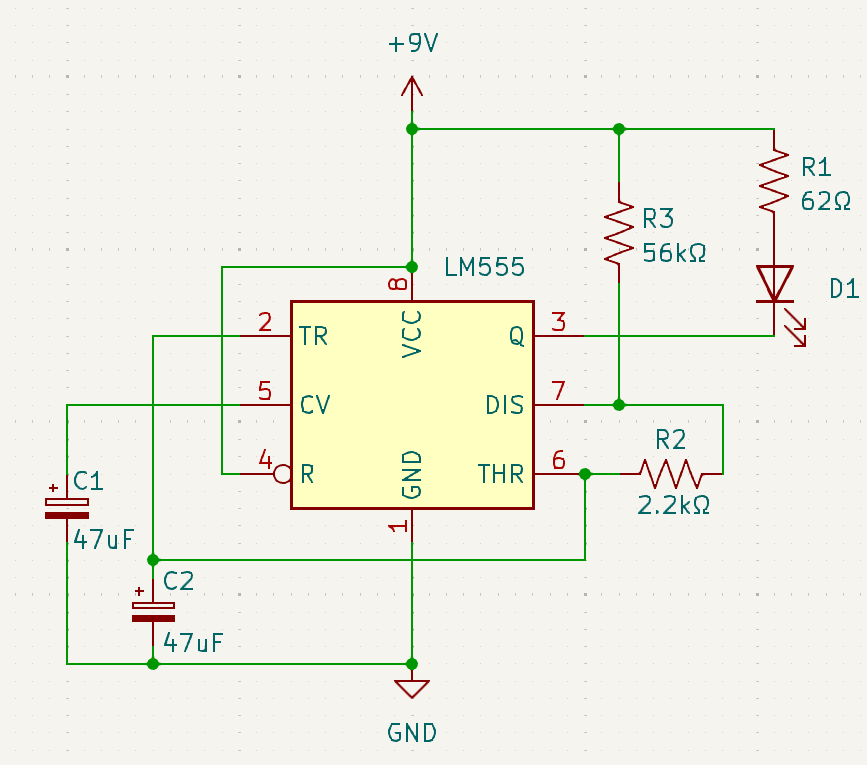
R2 = Discharge cap
Firstly, current flows through R1 and R2, charging C1 (pin 3 = High)
Secondly, once V_C1 = 2/3 * V_CC, pin 6 (threshold pin) toggles turning P3 low
Thirdly, C1 discharges through R2 until V_C1 = 1/3 * V_CC
IMPORTANT: Cap charges and discharges between 1/3 – 2/3 of the Supply voltage. This is because inside the cheeky NE555 there is a voltage divider formed by 3 resistors in series.
Simulation
In order to easily adjust the circuit, I prefer to simulate before I build.
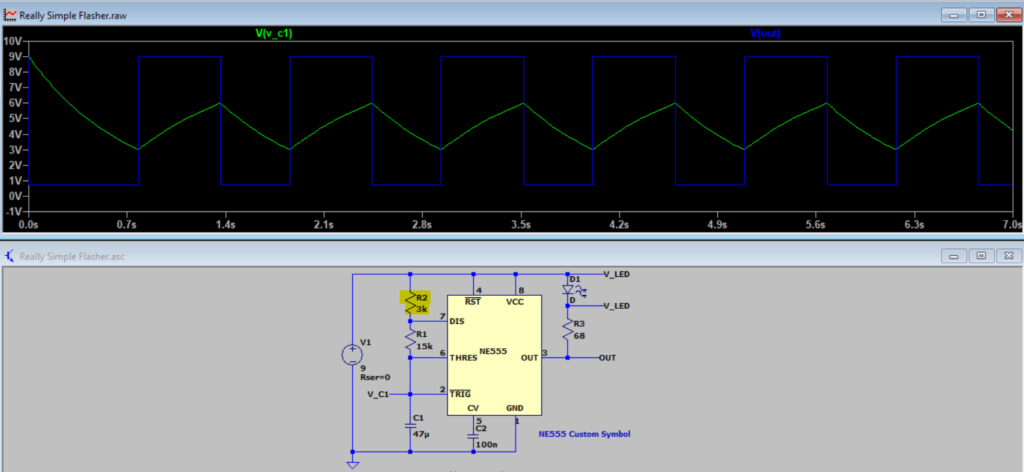
I recreated the circuit in falstad and LTspice and tinkered with the component values to attain a duty cycle I was happy with.
Falstad allows for a more visually-appealing simulation environment. LTspice is used to scrutinize the circuit